I said yesterday that I fully expected the Republican attack dogs to be set on Bob Woodward ahead of the publication of his new book which alleges that Bush ignored warnings over the need to send more troops to Iraq.
The White House now seem to have adopted a strategy of dismissing key parts of the book and dismissing the rest of it as somehow being "old news". It's similar to the way Snow wishes to deal with Clinton's allegations regarding bin Laden. They simply choose "not to engage".
"In a lot of ways, the book is sort of like cotton candy -- it kind of melts on contact," White House spokesman Tony Snow said at a briefing dominated by the topic. "We've read this book before. This tends to repeat what we've seen in a number of other books that have been out this year where people are ventilating old disputes over troop levels." Snow said it was well known that events in Iraq have been difficult and that officials have debated the right approach. "Rather than a state of denial," he said, "it's a state of the obvious."
"State of the obvious". It's a good line, but it doesn't go anywhere near addressing the points raised in Woodward's tome.
One of the most incendiary is the sheer amount of people who wanted Bush to remove Donald Rumsfeld from his post; Colin Powell, Condaleeza Rice and even Laura Bush all thought Rummy should go.
The book reports that then-White House Chief of Staff Andrew H. Card Jr. twice suggested that Bush fire Rumsfeld and replace him with former secretary of state James A. Baker III, first after the November 2004 election and again around Thanksgiving 2005. Card had the support of then-Secretary of State Colin L. Powell and his successor, Condoleezza Rice, as well as national security adviser Stephen J. Hadley and senior White House adviser Michael J. Gerson, according to the book.
Even first lady Laura Bush reportedly told Card that she agreed Rumsfeld had become a liability for her husband, although she noted that the president did not agree. "I don't know why he's not upset with this," she told Card, according to the book. But Vice President Cheney and senior Bush adviser Karl Rove argued against dumping Rumsfeld, and Bush agreed.
Apparently the reason given by Cheney and Rove was that the President might be criticised as the removal of Rumsfeld might imply that the war in Iraq was being fought in the wrong way.
Now, in my naivete, I would have thought that the decision on whether or not the Secretary of Defence should or should not be removed would have something to do with the good of the troops on the ground; it seems extraordinary to me that the decision is made with no consideration of the troops, but rather a lot of consideration on whether or not such a decision would embarrass the President.
It seems "the Decider" decides such important matters based solely on how it reflects on himself.
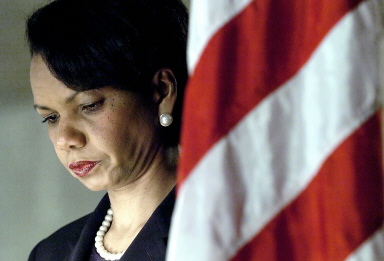
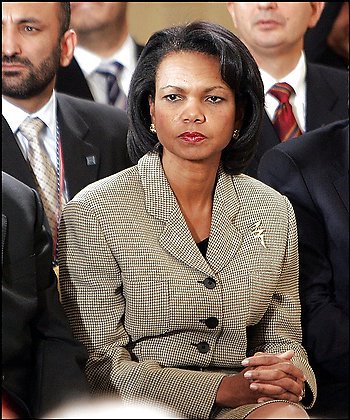
The other astonishing thing the book reveals is the staggering level of complacency exhibited by Condaleeza Rice.
The book also reports that then-CIA Director George J. Tenet and his counterterrorism chief, J. Cofer Black, grew so concerned in the summer of 2001 about a possible al-Qaeda attack that they drove straight to the White House to get high-level attention.
Tenet called Rice, then the national security adviser, from his car to ask to see her, in hopes that the surprise appearance would make an impression. But the meeting on July 10, 2001, left Tenet and Black frustrated and feeling brushed off, Woodward reported. Rice, they thought, did not seem to feel the same sense of urgency about the threat and was content to wait for an ongoing policy review.
The report of such a meeting takes on heightened importance after former president Bill Clinton said this week that the Bush team did not do enough to try to kill Osama bin Laden before the Sept. 11, 2001, attacks. Sen. Hillary Rodham Clinton (D-N.Y.) said her husband would have paid more attention to warnings of a possible attack than Bush did. Rice fired back on behalf of the current president, saying the Bush administration "was at least as aggressive" in eight months as President Clinton had been in eight years.
It is also noteworthy that Rice has never given any details of these supposedly "aggressive" actions and that when she has given concrete examples in the past, they have turned out to be
blatant lies.
It is also rather odd that this July 10 meeting is missing from the timeline reported by the 9-11 Commission. Is it because this meeting would shed bad light on to the administration? This certainly appears to be the impression held by J. Cofer Black.
Woodward wrote that Black "felt there were things the commissions wanted to know about and things they didn't want to know about."
Jamie S. Gorelick, a member of the Sept. 11 commission, said she checked with commission staff members who told her investigators were never told about a July 10 meeting. "We didn't know about the meeting itself," she said. "I can assure you it would have been in our report if we had known to ask about it."
White House and State Department officials yesterday confirmed that the July 10 meeting took place, although they took issue with Woodward's portrayal of its results. State Department spokesman Sean McCormack, responding on behalf of Rice, said Tenet and Black had never publicly expressed any frustration with her response.
And it's a sad day when your best defence is "You've never mentioned this before!" which appears to be the tack Sean McCormack is taking regarding Tenet and Black's criticisms.
However, the overall impression of a White House in denial certainly corresponds to every public utterance Bush has made on the subject of Iraq. For the last three years it has been almost impossible to reconcile Bush's Iraq with any of the facts emanating from the ground.
"The president himself is out of touch with reality, is in denial as to what is happening in Iraq," Pelosi said. "That could be the only explanation for why he has withheld the truth to the American people."
I think Nancy is being overly generous in that reading. There are many other reasons for why the President could be withholding the truth. Not least of which is the competence of his entire administration.
The book is released next week.
Click title for full article.